
Who Owns the Design in OEM Jewelry Manufacturing
Ownership is settled before the first drawing, not after the first invoice. Under OEM you supply the design and the workshop produces it; under ODM the piece is co-created and the finished collection is still 100% exclusive to your brand. Whichever route you take, the moulds, the CAD files and the design set stay off the market — and the OEM/ODM clocks do not change: 3–4 weeks of production on top of a 25–30 day sampling window and 48-hour CAD.

Key takeaways
- OEM means you design and the workshop produces; ODM means the concept is developed with you and stays yours.
- Moulds, CAD files and the collection are not resold or published, under a 100% NDA.
- The same three published windows apply to both routes: 48 hours, 25–30 days, 3–4 weeks.
- Hallmarks are laser engraved with your logo, using 18KGP on gold-plated work, a 316L mark on steel and the S925 hallmark according to the base metal.
The ownership question in one line
The published phrasing is blunt: OEM is "you design, we produce", and ODM is "you inspire, we create". The first is a manufacturing contract against a file you already own. The second is a development contract in which the workshop's design and engineering teams build the piece around your brief, and the outcome is a collection that belongs to your label rather than a house range that other buyers can order.
Neither model transfers ownership to the workshop. What differs is who did the drawing, not who ends up holding it.
What stays out of circulation, and why it matters
Three assets are covered: the moulds cut for your designs, the CAD files that describe them, and the collection built from them. None of them is resold, none is shown to another buyer, and none is published as part of the manufacturer's own range. The 100% NDA sits over the whole arrangement rather than over a single document.
That matters most to brands whose designs are the product. A mould that leaks into a competitor's order is not a legal inconvenience, it is a season of lost sales, which is why the exclusivity clause is worth reading before tooling rather than after.
How an ODM collection is developed without becoming public
An ODM brief starts from sketches, photographs or a mood board, and the design team works through the six customisation groups with you: plating options, accent stones, the base metal, chains and findings, logo and hallmarks and the packaging set. Because the piece is drawn for your account, the drawing lives with your account.
This is the practical difference from buying a catalogue item and adding a logo. A catalogue piece is already in circulation; a developed piece enters circulation when your first order ships.
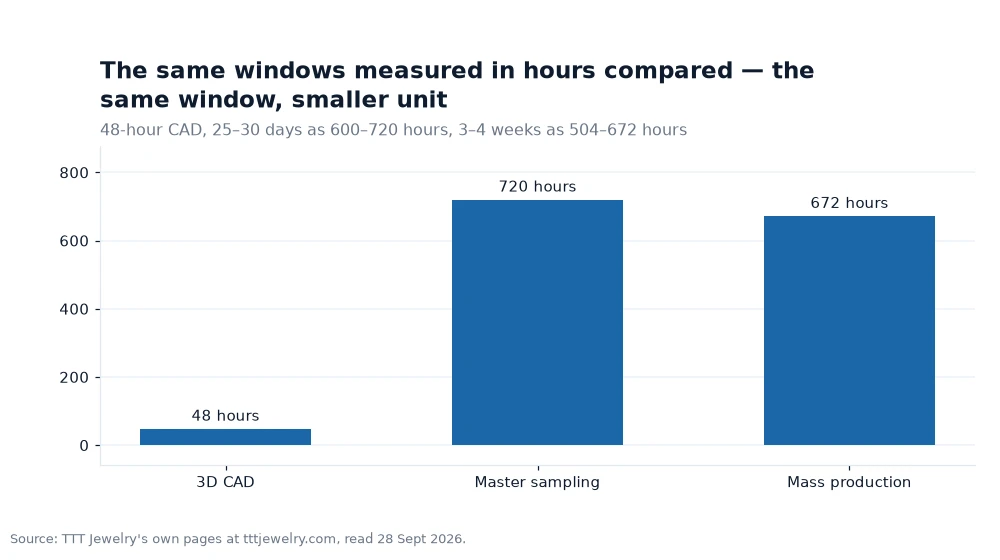
The three published windows, restated in hours
Publication in days hides how much time each stage really takes. Multiplying out to hours makes the ratio between them obvious, and it is the ratio that explains why buyers who push on the sample window rarely get anything back.
| Stage | Published window | Restated in hours |
|---|---|---|
| 3D CAD and renderings | under 48 hours | 48 |
| Master physical sample | 25–30 days | 600–720 |
| Mass production | 3–4 weeks | 504–672 |
The middle row is the one that runs the project. A single day inside the sampling block is worth 24 hours of bench time, and there is no equivalent shortcut on the drawing side because the drawing is already finished in two days.
Worked example: 30 days as 720 hours
At the outer edge of the published sampling window, 30 days × 24 hours = 720 hours. At the inner edge, 25 × 24 = 600 hours. Production restates the same way: 3 weeks is 21 days, so 21 × 24 = 504 hours, and 4 weeks is 28 days, which gives 28 × 24 = 672 hours — the two production bars on the chart above.
Set the CAD stage against the top of the sampling window and the proportions are stark: 48 ÷ 720 = 0.067, roughly 6.7%. Every multiplication and division here is mine; the 48-hour, 25–30 day and 3–4 week windows are the published ones.
What changes when the buyer supplies the drawing
When you arrive with your own file, one stage changes character: the consultation covers feasibility and cost structure rather than concept. Nothing about the sampling route changes, because the sample still has to be built through wax printing, casting, setting, polishing and plating, but the questions raised before drawing are narrower.
In practice those questions come down to three: is the wall thickness castable in the metal you named, does the stone seat fit the stone you specified, and will the hallmark fit on the surface you left free. A file with those three answers built into it moves through the CAD stage in the published 48 hours. A file that leaves them open gets a reply instead of a rendering, which is the most common reason a drawing misses its two-day turnaround.
What belongs in writing before tooling starts
Four sentences settle most disputes. One: the design and its CAD file remain the property of the buyer. Two: moulds are cut for the buyer's account and are not reused. Three: the collection is not offered, sold or shown to third parties under any circumstances. Four: the NDA covers the whole engagement, including the consultation stage before any drawing exists.
Ask for those in the first reply rather than in the contract. A supplier that splits the exclusivity promise from the price quote is telling you something about its document routine. Ownership is set out on the ODM jewelry manufacturer page itself, and the private-label program The standard questions cover the surrounding terms. shows how a design returns to the brand at the end of a run.
Frequently asked questions
Does the workshop own anything if it drew the piece?
No. Under the ODM model the workshop develops the design with you, and the resulting collection is exclusive to your brand rather than added to a house catalogue.
Can I move my design to another supplier later?
The design and CAD files are yours, and an ODM partner works to that understanding. Moulds are usually cut per account, so a move means new tooling rather than a transfer of files.
Are hallmarks covered by the same exclusivity?
Yes. S925, 316L and 18KGP marks are laser engraved alongside your logo during production, and the mark itself is a purity statement rather than a design element.
Getting ownership settled early, not late
The least costly moment to fix who owns what is before metal is cut, because tooling is where leverage disappears. Once a mould exists, a supplier is the only supplier for that design, and every later negotiation happens inside that fact.
Brands building a first collection for their own label usually want two documents in hand at the same time: the exclusivity terms, and the packaging line-up that turns a piece into a retail product — the private-label program pages cover the second. It is also worth seeing what the shop floor tour includes, because a factory willing to show the benches is usually a factory willing to show its paperwork.
The figures used above — the S925 / 316L / 18KGP hallmarks along with the ISO 9001:2015, BSCI and REACH certifications and the confidentiality terms — are drawn from the manufacturer's own pages at tttjewelry.com itself, read in full on 28 Sept 2026. Nothing else here is inferred. My re-orderings of the published facts are my own working, and nothing else here[1].