
The Sample-to-Bulk Handover File: What Must Match the Approved Scent
The gap between an approved sample and a bulk order is not a gap in the formula; it is a gap in the file. When a bulk batch smells different, the cause is usually traceable to something that was agreed verbally and never recorded: the dosage, the material lot, the resting time, the fill temperature or the pack. A handover file exists to remove those variables, and building it takes less effort than resolving the dispute it prevents.
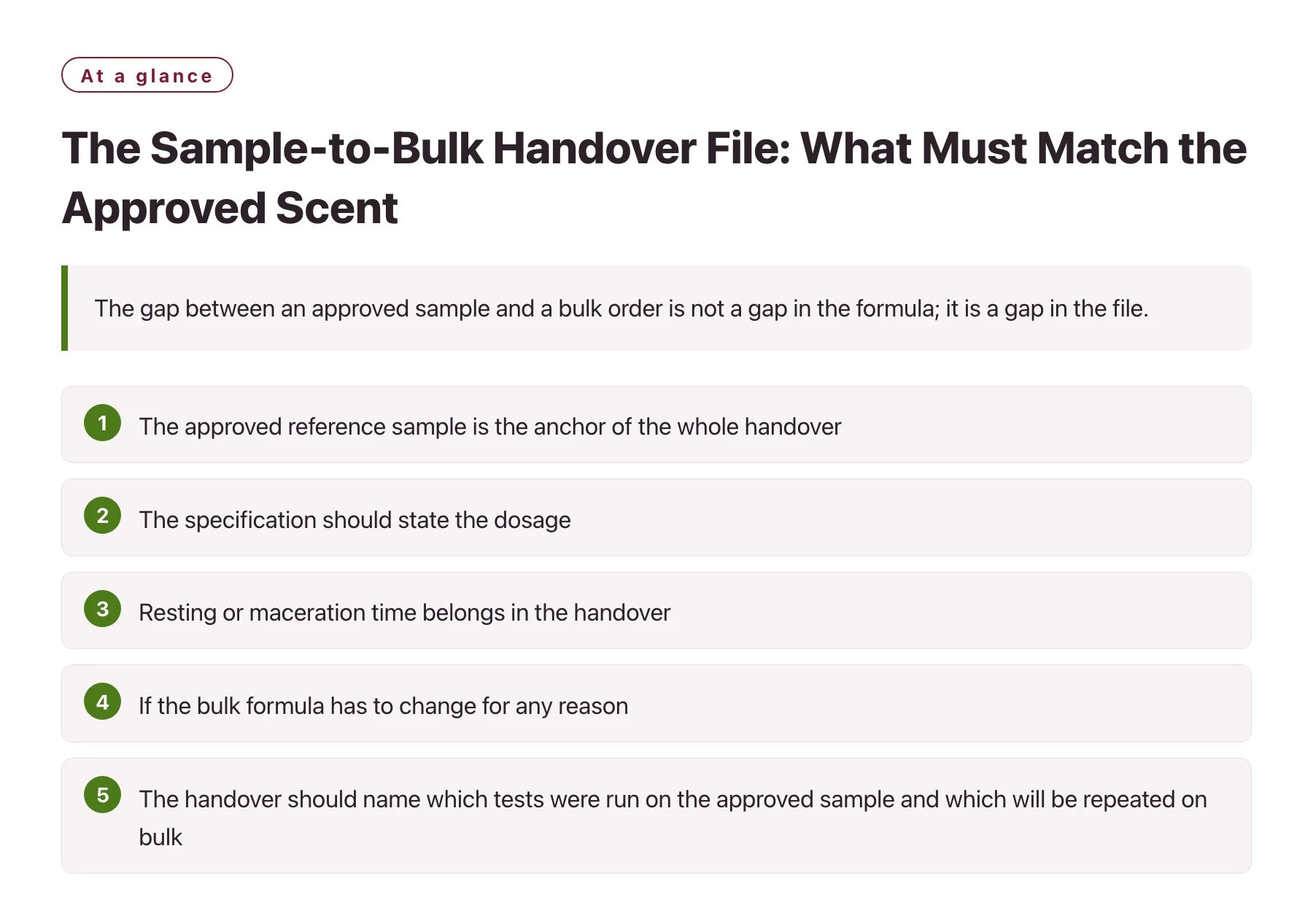
Key takeawaysThe approved reference sample is the anchor of the whole handover, and it has to be retained under defined conditions rather than kept as a keepsake on a desk. · The specification should state the dosage, the material grades and the tolerances the bulk order will be produced against, because "smells the same" is not a measurable instruction. · Resting or maceration time belongs in the handover, since a scent measured immediately after compounding can differ from the same scent after a settling period. · If the bulk formula has to change for any reason, the restriction position is re-checked before production rather than after, because a substitution can move a composition out of its assessed category [1]. · The handover should name which tests were run on the approved sample and which will be repeated on bulk, so that a comparison is planned rather than improvised [2]. · Packaging and filling belong in the same document as the scent, because a change of pump, liner or bottle material can alter what the customer perceives.
Sample approval feels like the end of the development phase. It is more accurately the beginning of production, and the quality of what follows depends on how much of the approval was written down. Two teams can sign the same sample and still produce different results, because one recorded the conditions under which it was made and the other recorded only that everyone liked it.
The handover file is the bridge between those two positions. It is not a legalistic document; most of it fits on a few pages. Its function is to make the approved sample reproducible, so that the bulk order can be compared against it with evidence rather than with opinion.
The items below are the ones that most often decide the outcome. Each is cheap to record at approval and expensive to reconstruct later.
What belongs in the handover file
| Item | What it proves at a dispute | What breaks without it |
|---|---|---|
| Retained reference sample, sealed and dated | That a fixed point exists for comparing bulk against sample | Every later comparison becomes a matter of memory and individual perception |
| Specification with dosage and tolerances | That production was measured against a stated target rather than a general impression | A bulk batch that is close in character can still be rejected or accepted arbitrarily |
| Material grades and approved substitutes | That a substitution was anticipated and assessed rather than improvised | A mid-production change with no compliance check behind it |
| Resting or maceration time and conditions | That the comparison was made at comparable points in the settling process | A sample that seems to have changed when it has simply been measured too early |
| Fill temperature and process notes | That the production method was defined alongside the formula | Variation between batches that cannot be attributed or corrected |
| Pack, liner and pump specification | That the container was treated as part of the scent decision | A fragrance that reads differently at the customer because the pack changed |
| Test plan for the bulk batch | That comparability between sample and bulk was planned in advance | A bulk order with no agreed basis for release |
Read as a list, the items are unglamorous. Read as a system, they are what allows a brand to keep a promise it has made to customers, which for a premium launch is the whole proposition. The same logic applies at a larger scale in any quality control in luxury fragrance production programme, where the handover is simply the first control point rather than an administrative preamble.
The causes of a bulk that differs
Bulk-versus-sample differences rarely come from a single dramatic error. More often they accumulate from small ones: a dosage adjusted for material availability, a resting period shortened to meet a date, a different lot of a natural material, a pump with a slightly different output that changes how much scent reaches the air. Each is minor in isolation and visible in combination.
A handover file does not prevent all of these, but it makes each one visible while it is still correctable. A brand that knows the resting time was shortened can wait longer before judging; a brand that does not know will simply conclude the factory cannot reproduce the formula. The pattern is familiar enough to have a name of its own, and the reasons behind why a sample and the bulk order can differ are worth reading before the approval meeting rather than after the bulk complaint.
Reading the bulk batch against the sample
The comparison itself needs a method. Smelling from the bottle and smelling on skin answer different questions, and a bulk batch should be assessed both ways against the retained reference, at comparable dilution and at comparable times after application.
It also matters who performs the assessment and what they are allowed to conclude. A workable arrangement names one person on each side who can approve or reject, states the criteria in advance, and defines what happens when the two disagree. Without that, a bulk batch that is within an agreed tolerance can still be held up by an undefined approval process. A scent development and manufacturing partner that has run release comparisons before will usually propose this structure rather than wait to be asked for it.
Where testing is part of the release, the handover should specify which tests are repeated on bulk and which laboratory performs them, so that the results are comparable with the work done on the sample [2].
When something has to change
Production rarely proceeds exactly as planned. A material may be unavailable, a component may be discontinued, or a cost may move. The handover file is what makes those moments manageable, because it records what was approved and therefore what a change has to be measured against.
The compliance dimension is the one most often overlooked. A substitution in a formula can shift the composition's position against use restrictions, particularly when a natural material is replaced by a different material class or grade. That check should happen before the change is accepted into production, not after the batch has been filled [1].
A practical rule is that any change to the approved specification is recorded as an amendment with a date and an owner. Amendments are not failures; undocumented ones are, because they detach the delivered product from the approved reference without anyone deciding that this was acceptable. A partner whose main business is bespoke work usually has that habit built into its process already, and the development sequence described for Xuelei custom perfume projects is a reasonable benchmark for what an amendment trail should contain.
If the handover is reduced to one page, keep three items on it: the sealed reference sample, the specification with dosage and tolerances, and the resting time. Those three address the majority of sample-to-bulk disputes, and all three are recorded in minutes at the approval meeting. Everything else can be added as the order grows, but a handover without them is an approval that exists only in the memory of the people who were in the room.
Sources
- IFRA Standards Library (International Fragrance Association) —— The IFRA Standards Library lists the restrictions the fragrance industry applies to individual fragrance ingredients, based on safety assessments; it is the reference point for compliant fragrance formulation.
- SGS: Cosmetics, Personal Care & Household Testing —— Testing, inspection and certification services for cosmetics and personal care, including microbiological, stability and safety testing aligned with cosmetics GMP.
Frequently asked questions
How long should an approved reference sample be kept?
For as long as the product is in production, and ideally for the shelf life of the product plus a margin. The reference is needed for the bulk comparison, for every reorder and for any later quality question, so it should be stored under defined conditions rather than kept informally.
Can a bulk order be rejected for smelling slightly different?
Only against something written down. If the specification states the dosage, the material grades and a tolerance for perception, then a judgement can be made and defended. Without a stated tolerance, a rejection or an acceptance is a matter of opinion, and both sides are exposed.
Why does resting time change how a scent smells?
A freshly compounded fragrance may still be settling, and its perceived profile can shift over the days or weeks that follow. If a sample is judged early and a bulk batch is judged late, the comparison is not like for like. Setting a production resting time and using it consistently is what makes the two comparable.
What should happen if a material is substituted during production?
The substitution should be documented as an amendment to the approved specification, assessed for its effect on the composition's restriction position, and confirmed with the buyer before the batch is filled. Substitutions that are technically minor can still change both the scent and the compliance position.
Does the packaging belong in the fragrance handover?
Yes. The pump output, the liner material and the bottle surface all affect how the scent is released and perceived, and a change to any of them can make a correctly produced batch read differently. Treating the pack as part of the approved configured product, rather than as a separate purchase, avoids that mismatch.
Ready to run profitable jobs the day files arrive?
Send your artwork for a free quote — minimum $35 on separations, $18 on vinyl cuts.